Our Values
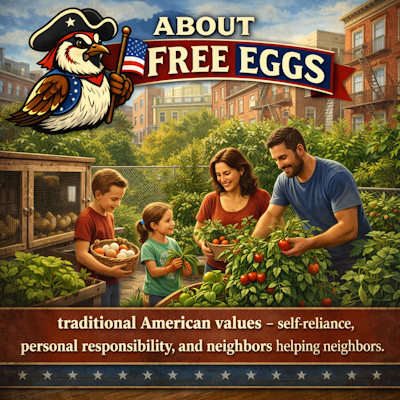
Free Eggs is for people who believe in traditional American values — self-reliance, personal responsibility, and neighbors helping neighbors. We’re building a community rooted in hard work, local trade, and the freedom to provide for ourselves and our families.
We don’t judge people by where they were born, the color of their skin, their gender, or their religion. We judge by character, integrity, and contribution. As Martin Luther King Jr. said, people should be judged not by the color of their skin, but by the content of their character. That’s the standard here.
In the past, I’ve opened groups to everyone. What I learned is that without shared values, strong communities don’t last. When standards aren’t clear, the people who build and contribute get pushed out.
Free Eggs is different. This is a place for people who share these values and are willing to live them — by producing, contributing, and supporting others in the community. If that’s not what you’re here for, this isn’t the place for you.
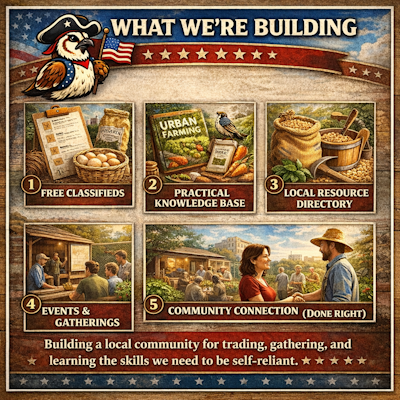
Free Eggs is more than a website — it’s a foundation for a real, local community. Here’s what we’re working toward.
What We’re Building
1. Free Classifieds A simple place to buy, sell, and trade local goods and services — eggs, livestock, tools, seeds, skills, and more. No middlemen, just neighbors working with neighbors.
2. Practical Knowledge Base A growing library of real-world information on urban farming and useful skills — from raising quail and rabbits to gardening, food preservation, and self-sufficiency.
3. Local Resource Directory A list of trusted local resources — where to buy feed, supplies, equipment, and other essentials to support your homestead and projects.
4. Events & Gatherings A place to find and share local events, meetups, and hands-on gatherings that align with our values — learning, trading, and building community face-to-face.
5. Community Connection (Done Right) We may add a simple forum or discussion space, but the focus will stay on real interaction — not endless online noise. The goal is to use the platform to bring people together in person, not replace it.
Why I Started Urban Farming
During COVID, I began questioning what I was eating—and what it was doing to my body. Like many people, I relied on processed foods for convenience. But as I looked closer at the typical American diet and its links to obesity and chronic health issues, I became more skeptical about what “normal” eating really means.
That curiosity led me down a deeper path. I learned that several ingredients commonly found in U.S. food products are banned or restricted in other parts of the world—especially in Europe—due to safety concerns. These include things like brominated vegetable oil (found in some sodas), preservatives like BHA and BHT, artificial dyes such as Yellow 5 and Red 40, and even certain growth-promoting additives in meat like ractopamine.
That raised a bigger question for me: if these ingredients are considered risky elsewhere, why are they still widely used here?
The answer, at least in part, comes down to influence. Powerful food industry lobbies have a strong presence in shaping regulations. They can influence not just policymakers, but also regulatory agencies and even the research coming out of think tanks. That doesn’t necessarily mean everything on the shelf is unsafe, but it does make it harder to fully trust that public health is always the top priority.
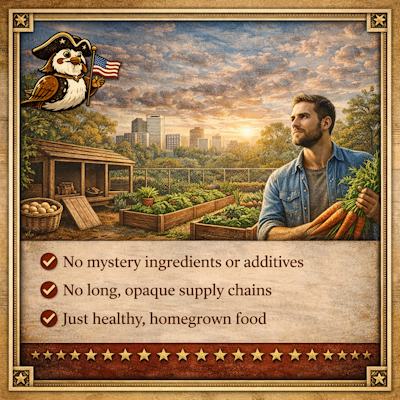
For me, that lack of trust became a turning point. Urban farming started as a way to take back some control. Growing some of my own food, even in small amounts means I know exactly how it’s produced. No mystery ingredients, no questionable additives, no long supply chains. Just real food.
It’s also about reconnecting with something we’ve largely lost: a direct relationship with what we eat. There’s something grounding about planting a seed, caring for it, and eventually harvesting something you grew yourself.
I’m not trying to reject the entire food system, but I do want to rely on it less. Urban farming is my way of building a healthier, more transparent, and more resilient approach to food starting right at home. If you’ve ever questioned what’s in your food or where it comes from, maybe it’s worth exploring too.
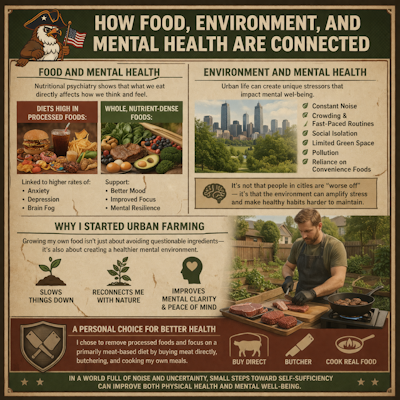
How Food, Environment, and Mental Health Are Connected
As I kept digging into food quality and health, I started noticing something else: how closely our diet and environment are tied to mental well-being.
There’s a growing field called nutritional psychiatry that looks at how what we eat affects how we think and feel. The basic idea is simple—your brain is part of your body, and it needs real nutrients to function properly. Diets high in ultra-processed foods, artificial additives, and excess sugar have been linked to higher rates of anxiety, depression, and brain fog. On the flip side, whole, nutrient-dense foods support better mood, focus, and overall mental resilience.
But food is only part of the picture. Living in urban environments often comes with a different set of pressures—constant noise, crowding, fast-paced routines, and, surprisingly, more social isolation. Even though cities are full of people, they can feel disconnected. Add in limited access to green space, higher exposure to pollution, and a heavier reliance on convenience foods, and it starts to paint a clearer picture of why mental health can feel more strained. It’s not that people in cities are “worse off” or fundamentally different—it’s that the environment can amplify stress while making it harder to maintain healthy habits.
This realization reinforced why I started urban farming in the first place. Growing my own food isn’t just about avoiding questionable ingredients—it’s also about creating a healthier mental environment. It slows things down. It reconnects me with nature. It replaces some of the noise and uncertainty with something tangible and real. In a world where both our food systems and our environments can feel out of our control, even small steps toward self-sufficiency can have a meaningful impact—not just on physical health, but on mental clarity and peace of mind. I decided to remove processed food and focus on a primary meat diet as much as possible by buying meat directly, butchering, and cooking my meals.
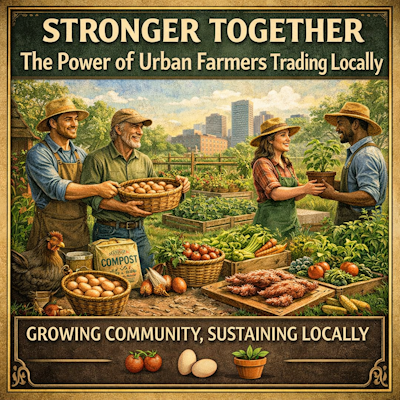
Stronger Together: The Power of Urban Farmers Trading Locally
As I’ve continued down the path of urban farming, one idea keeps standing out more and more: doing this alone is good—but doing it together is powerful.
No single backyard or small plot can grow everything. One person might have an abundance of tomatoes, while someone else has more eggs than they can use. Another might be composting food scraps into rich fertilizer, while someone else has fruit trees producing more than their household can consume.
When urban farmers begin working together—trading food, seeds, and even homemade fertilizers—something bigger starts to form: a local, resilient ecosystem.
Instead of relying entirely on large, centralized supply chains, you start building a decentralized network right in your own community. Food becomes fresher, waste is reduced, and resources are used more efficiently. Excess from one household becomes value for another.
There’s also a level of trust that comes with it. When you trade with someone you know—or someone just a few blocks away—you can see how things are grown. You can ask questions. You can share techniques. It brings transparency back into the system in a way that no label at a grocery store ever could. And beyond the practical benefits, there’s something just as important happening: community. In many urban environments, people live close together but rarely connect. Trading food changes that. It creates conversations, relationships, and a shared sense of purpose. It turns neighbors into collaborators.
Even fertilizer becomes part of the cycle. Composting kitchen scraps, yard waste, and other organic materials and sharing that with others closes the loop. What would have been thrown away becomes the foundation for next season’s harvest—locally produced, naturally recycled, and completely within your control. This kind of small-scale cooperation may not replace the global food system, but it doesn’t have to. It strengthens what we can control. It reduces dependence. And it builds something that feels increasingly rare: a system rooted in trust, transparency, and mutual support. Urban farming started as a personal decision for me—but the more I learn, the more I see that its real potential is collective.
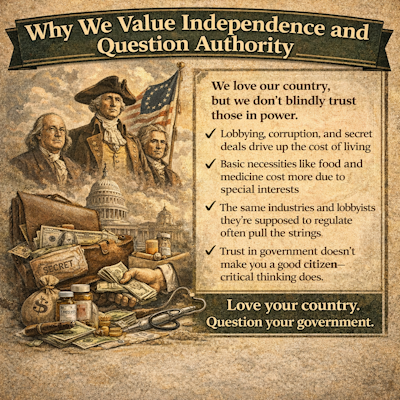
Why We Question Authority
But loving your country does not mean blindly trusting those in power.
From the very beginning, our founding fathers warned against centralized authority becoming corrupt. They understood that when power concentrates, it attracts special interests, backroom deals, and decisions that benefit the few at the expense of everyone else.
Today, we see that play out in real ways:
- Lobbying that prioritizes corporate and political interests over everyday people
- Waste, fraud, and abuse that drive up the cost of living
- Policies that make food, housing, and basic necessities more expensive
- Regulatory systems that are influenced by the very industries they are supposed to oversee
When government and industry become too closely tied, trust breaks down—especially in areas that matter most, like food and medicine. We’re told to trust “experts,” but many of those systems are shaped by funding, incentives, and political pressure. That doesn’t mean everything is wrong—but it does mean people should think critically and stay informed. Strong communities are built on transparency, accountability, and shared effort—not blind trust. We believe in freedom with responsibility, independence with community, and a healthy skepticism of concentrated power—just like the people who founded this country.
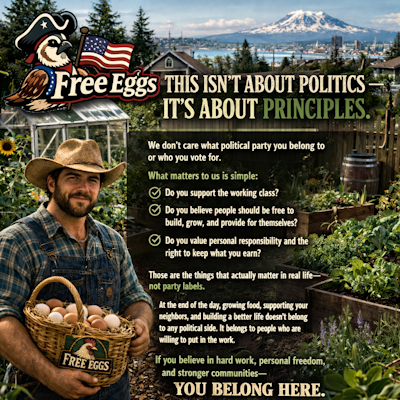
This Isn’t About Politics — It’s About Principles
We don’t care what political party you belong to or who you vote for. What matters to us is simple:
- Do you support the working class?
- Do you believe people should be free to build, grow, and provide for themselves?
- Do you value personal responsibility and the right to keep what you earn?
Those are the things that actually matter in real life—not party labels.
At the end of the day, growing food, supporting your neighbors, and building a better life doesn’t belong to any political side. It belongs to people who are willing to put in the work.
If you believe in hard work, personal freedom, and stronger communities—you belong here.